Episode Transcript
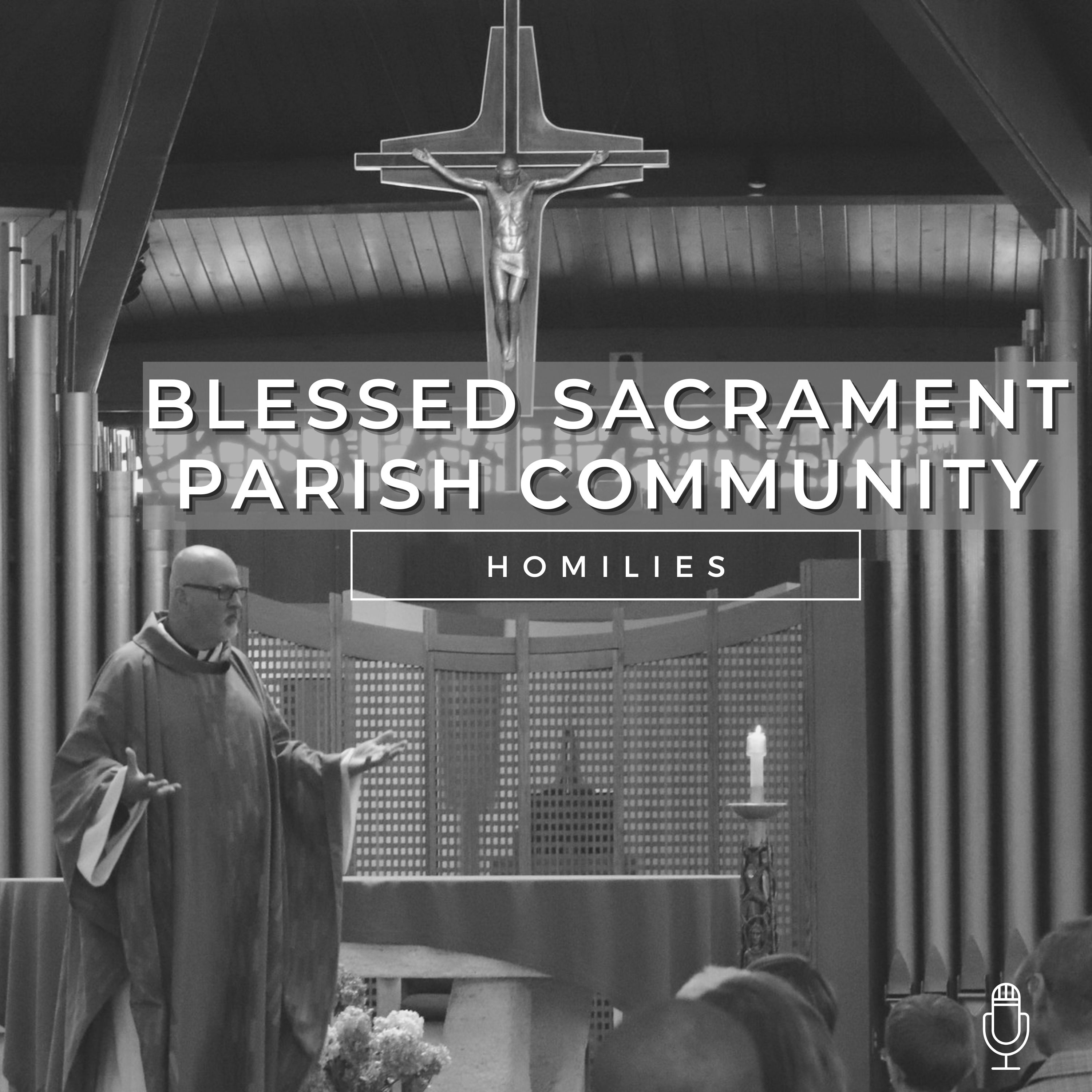
[00:00:12] Speaker A: Welcome to the Blessed Sacrament Homilies podcast where our mission is to help everyone recognize and experience the presence of God. We hope you are nourished and encouraged by the Word. Thank you for joining us.
[00:00:26] Speaker B: The Lord be with you and with your spirit. A reading from the Holy Gospel according to Matthew. Glory to you, O Lord. At that time, Jesus exclaimed, I give praise to you, Father, Lord of heaven and earth.
For although you have hidden these things from the wise and the learned, you have revealed them to the little ones.
Yes, Father, such has been your gracious will.
All things have been handed over to me by my Father.
No one knows the Son except the Father, and no one knows the Father except the Son and anyone to whom the Son wishes to reveal him.
Come to me all you who labor and are burdened, and I will give you rest.
Take my yoke upon you and learn from me, for I am meek and humble of heart.
And you will find rest for yourselves.
For my yoke is easy and my burden light the Gospel of the Lord.
Praise to you, Lord Jesus Christ.
One of the most powerful things Jesus did during his public ministry is he would take words and understandings of things that to most everyone were seen as horrific, shameful, painful to be avoided.
And he would turn them 180 degrees and all of a sudden make them life giving and full of grace and a chance to encounter the profound love of God.
The best example of all is the cross, a Roman method of execution that was meant to be a warning for all who witnessed it, don't mess with Rome.
It was meant to be shameful, it was meant to be torturous, and it was meant to control the people.
And he took that symbol, that thing, and turned it into a symbol of life, a symbol of love and a symbol of grace.
And he made it our symbol as well.
To the horrific marks of the crucifixion, the nail marks and the spear, things that would have been repulsive, things that people would have turned away from.
After the resurrection, we're transformed into something that was a testimony of God's profound love for us.
And we're no longer horrific, they were changed.
Another thing he used is present in this gospel because he uses the image of the yoke, something to control a beast of burden, to plow fields, to pull carts and chariots, to do backbreaking work.
And he uses that image of the yoke to allow us to understand that the yoke of Christ, the one where we're tied to him and he's tied to us, is no longer something to drag us down no longer something to turn us into a slave, but instead is an image of love and of grace and of freedom.
He does that by reminding us that when we take that yoke on, we're no longer alone.
It's a dual yoke and he's on the side of us.
And it's that presence when we are weary and find life burdensome that gives us strength. When we can go no longer, that gives us life. When this life comes to an end, that gives us hope when seemingly there is no hope.
He's reminding us that when we trust enough to live in him, all of those struggles, all of all of those things we face suddenly can become bearable.
And it doesn't mean that suffering goes away, but it does mean to us that we never walk alone.
And that when we can go on no longer, he's the one there to lift us up and to give us life.